

The manufacturing process of powder metallurgy gears mainly relies on powder pressing + sintering to achieve near-net shaping. Compared with traditional machining, it has the advantages of high material utilization, low production cost, and suitability for mass production. The specific steps are as follows:
1. Raw Powder Preparation and Formula Design
This is the fundamental step that determines the performance of the gear. The powder composition should be selected based on the gear's operating conditions (load, speed, wear resistance requirements).
Main powders: Common iron powders (such as reduced iron powder and water-atomized iron powder) are used as the base. To improve strength and wear resistance, copper powder or nickel powder can be added; for self-lubricating properties, graphite powder can be added (forming free graphite after sintering).
Auxiliary additives: Lubricants/binders such as zinc stearate and paraffin are added. They serve to improve powder flowability for easier mold filling and reduce friction between the powder and the mold to extend mold life.
Mixing process: All powder components are placed in a mixer (such as a V-type mixer or conical mixer) for uniform mixing. Mixing time is typically 10-60 minutes to ensure consistent distribution and avoid local performance differences.
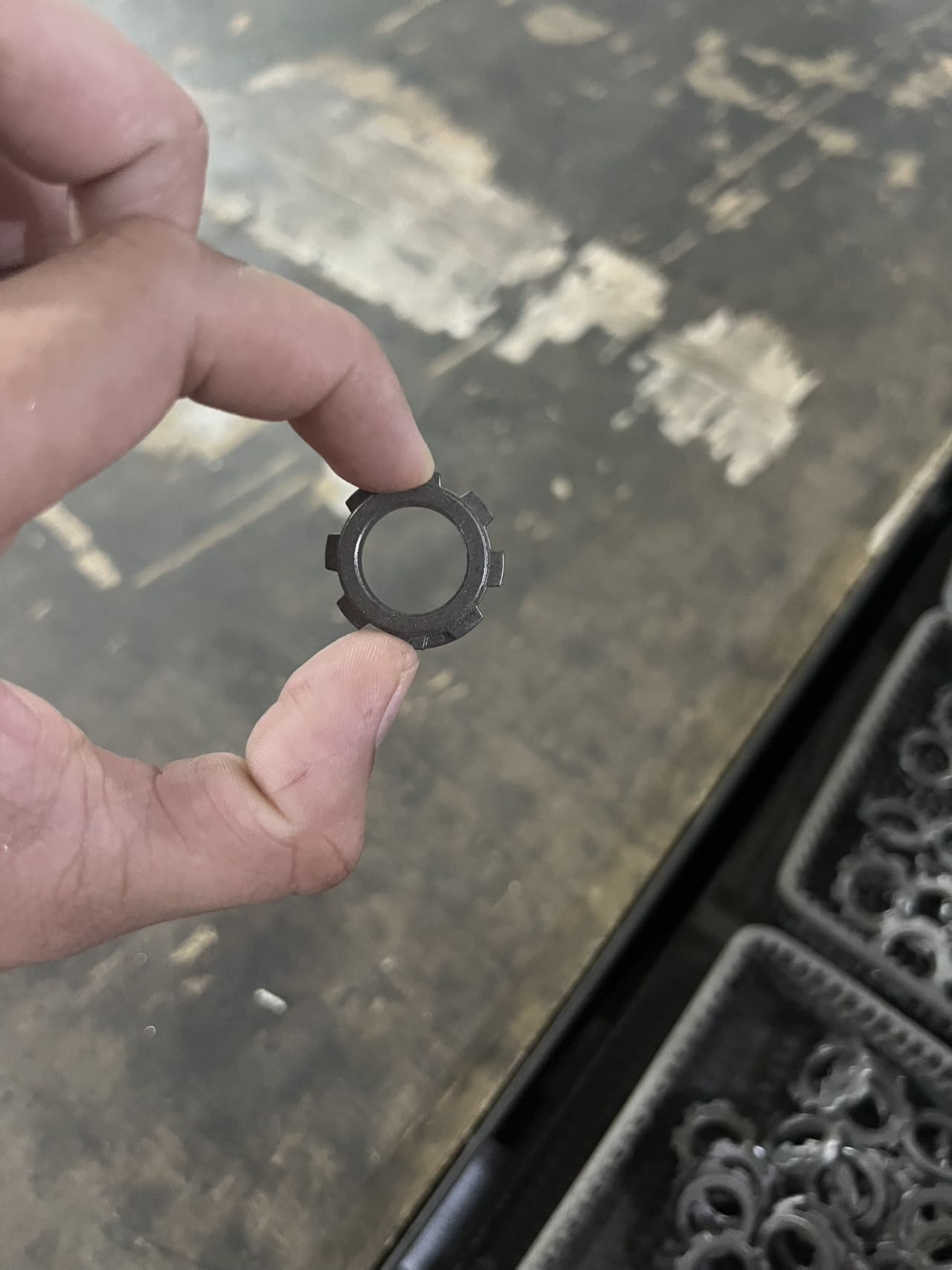
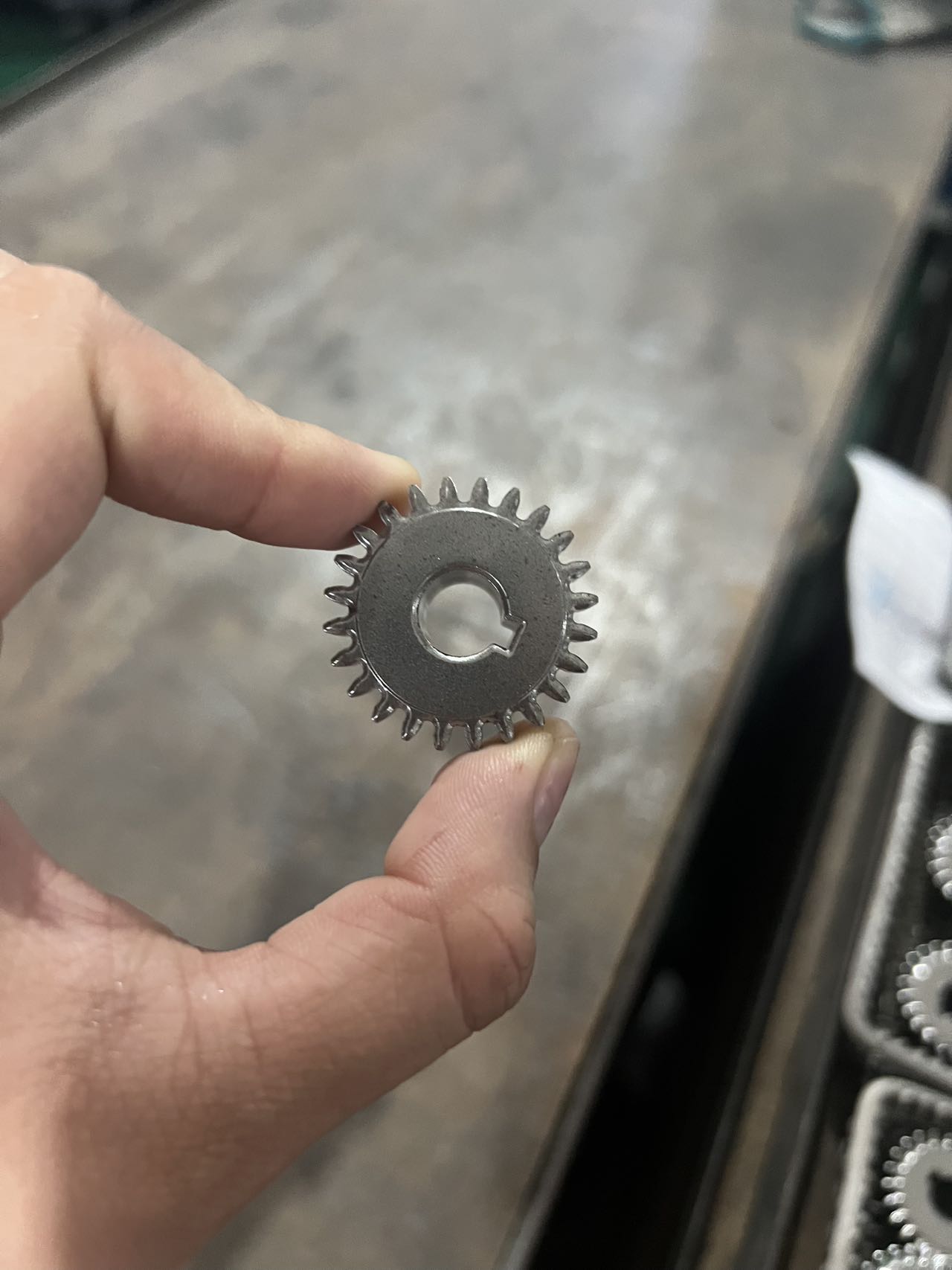
Sintering (Critical Curing Process)
Sintering is the core step of converting green into sintered bodies with metal strength, and atomic diffusion and fusion occur between powder particles through high-temperature heating to form metallurgical bonds.
Sintering equipment: use continuous sintering furnace or pushrod type sintering furnace, which is divided into preheating zone, high temperature zone and cooling zone, which can achieve continuous production.
Sintering atmosphere: It must be done in a protective atmosphere to prevent the powder from oxidizing. Common atmospheres include:
Reducing atmosphere: hydrogen, ammonia decomposition gas (75% H₂+25% N₂), suitable for iron powder base gears;
Inert atmosphere: nitrogen, argon, suitable for alloy powder gears containing copper and nickel.
Sintering parameters:
Temperature: Iron powder base gear is usually 1100-1250°C;
Time: The high temperature preservation time is 30-120 minutes, if the time is too short, the metallurgical combination is insufficient and the strength is insufficient; Too long time can easily lead to coarse grains and reduce toughness.
Post-sintering changes: The green will shrink slightly (generally 5%-15%), reduce the volume, increase the density, and greatly increase the strength and hardness.
Oil immersion: Put the gear into the lubricating oil, use capillary action to make the oil penetrate into the pores inside the gear, achieve self-lubrication, reduce operating noise and wear, often used in transmission gears, reduction gears.
Heat treatment: If the gear requires high hardness and high wear resistance, it can be carburized and quenched, carbonitriding and other heat treatments, and the surface hardness can reach HRC 58-62, and the core remains tough to avoid impact fracture.
Machining: For high-precision gears (such as ISO 5-7 grades), gear grinding is also required after finishing to correct tooth shape errors to meet the needs of high-speed and high-precision transmission.
Surface treatment: According to the needs of rust prevention, blackening, galvanizing, phosphating and other treatments can be carried out.
6. Inspection and packaging
Quality Inspection: Inspection items include tooth shape accuracy, dimensional tolerances, density, hardness, tensile strength, and cosmetic defects (such as cracks, porosity, missing teeth) to ensure compliance with customer requirements.
Packing into storage: Qualified gears are put into the warehouse after anti-rust packaging, waiting for them to leave the factory
Sintering is the core step of converting green into sintered bodies with metal strength, and atomic diffusion and fusion occur between powder particles through high-temperature heating to form metallurgical bonds.
Sintering equipment: use continuous sintering furnace or pushrod type sintering furnace, which is divided into preheating zone, high temperature zone and cooling zone, which can achieve continuous production.
Sintering atmosphere: It must be done in a protective atmosphere to prevent the powder from oxidizing. Common atmospheres include:
Reducing atmosphere: hydrogen, ammonia decomposition gas (75% H₂+25% N₂), suitable for iron powder base gears;
Inert atmosphere: nitrogen, argon, suitable for alloy powder gears containing copper and nickel.
Sintering parameters:
Temperature: Iron powder base gear is usually 1100-1250°C;
Time: The high temperature preservation time is 30-120 minutes, if the time is too short, the metallurgical combination is insufficient and the strength is insufficient; Too long time can easily lead to coarse grains and reduce toughness.
Post-sintering changes: The green will shrink slightly (generally 5%-15%), reduce the volume, increase the density, and greatly increase the strength and hardness.
Oil immersion: Put the gear into the lubricating oil, use capillary action to make the oil penetrate into the pores inside the gear, achieve self-lubrication, reduce operating noise and wear, often used in transmission gears, reduction gears.
Heat treatment: If the gear requires high hardness and high wear resistance, it can be carburized and quenched, carbonitriding and other heat treatments, and the surface hardness can reach HRC 58-62, and the core remains tough to avoid impact fracture.
Machining: For high-precision gears (such as ISO 5-7 grades), gear grinding is also required after finishing to correct tooth shape errors to meet the needs of high-speed and high-precision transmission.
Surface treatment: According to the needs of rust prevention, blackening, galvanizing, phosphating and other treatments can be carried out.
6. Inspection and packaging
Quality Inspection: Inspection items include tooth shape accuracy, dimensional tolerances, density, hardness, tensile strength, and cosmetic defects (such as cracks, porosity, missing teeth) to ensure compliance with customer requirements.
Packing into storage: Qualified gears are put into the warehouse after anti-rust packaging, waiting for them to leave the factory
