

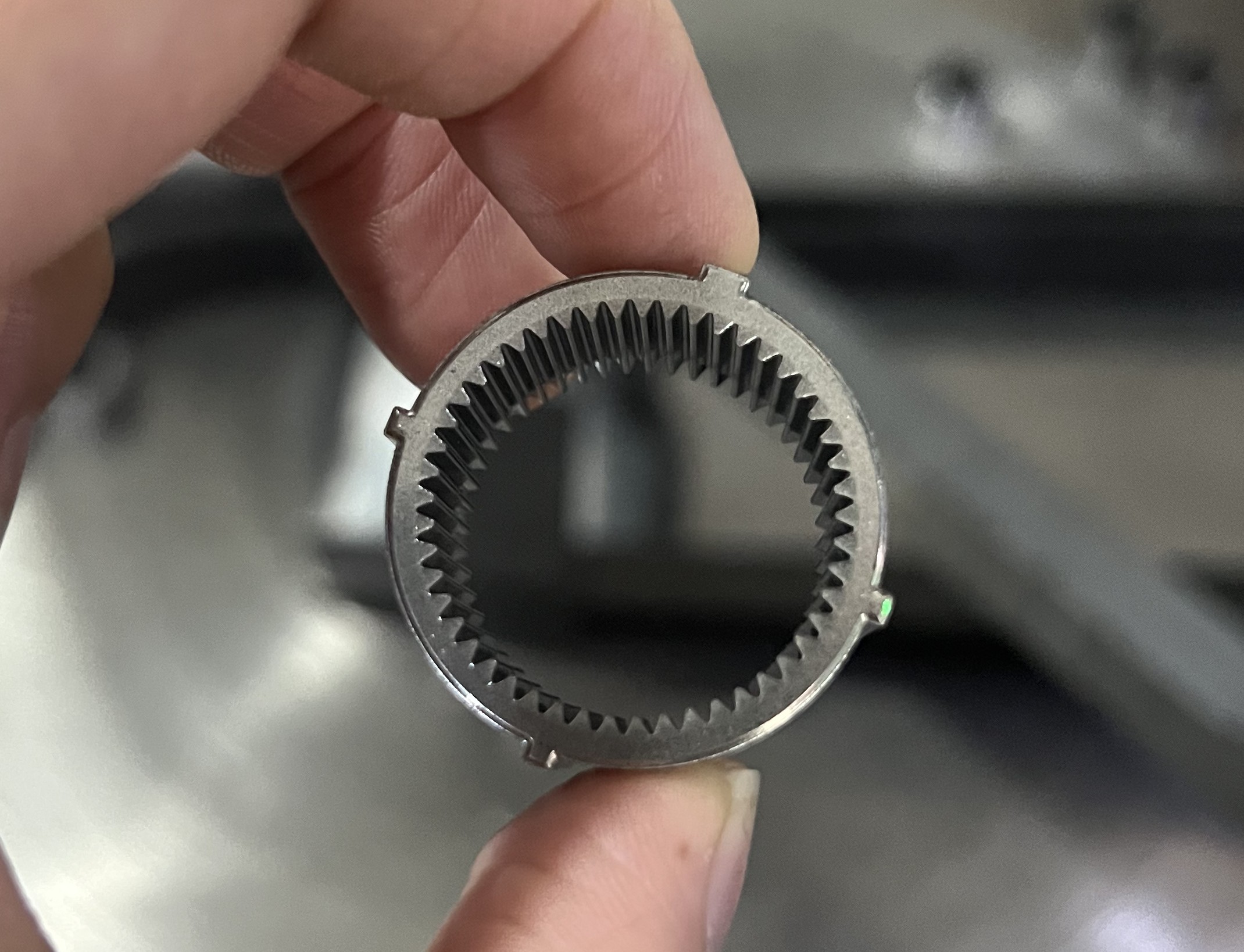
There are numerous methods for manufacturing gears, among which hobbing, milling, and broaching are particularly prominent. However, there is another manufacturing method—the powder metallurgy process, which produces gears by pressing metal powders into shape. Powder metallurgy gears are widely used in automotive engines, with their cost-effectiveness being especially notable in mass production. Next, we will take an in-depth look at the advantages and disadvantages of powder metallurgy gears.
Overview of Advantages:
- The manufacturing process of powder metallurgy gears is relatively simple, reducing unnecessary steps.
- This process has a very high material utilization rate, exceeding 95%, effectively lowering costs.
- Because powder metallurgy gears are pressed using molds, their repeatability is excellent; a single mold can press tens of thousands to hundreds of thousands of high-quality gear blanks.
- The powder metallurgy method allows for the integration of multiple components into one piece, improving production efficiency.
- The material density of powder metallurgy gears can be controlled and adjusted according to requirements.
- During the pressing process, to ensure that the blanks can be smoothly ejected from the mold, the roughness of the mold working surface is carefully designed, ensuring the quality of the formed gears.
Disadvantages:
The powder metallurgy process is generally suitable for large-scale production, with a batch size of at least 5,000 pieces to fully leverage its advantages.
The pressing capacity of the press imposes some limits on gear sizes. Presses typically have pressures ranging from a few tons to several hundred tons, and their applicable diameter range is basically limited to within 110 millimeters.
Powder metallurgy gears have certain structural limitations. Due to the characteristics of pressing and molds, this process is not very suitable for manufacturing worm gears, herringbone gears, or helical gears with a helix angle greater than 35 degrees. For helical gears, it is recommended to keep the helix angle within 15 degrees.
The thickness of powder metallurgy gears is also somewhat restricted. The mold cavity depth and press stroke must be at least 2 to 5 times the gear thickness, while also considering the uniformity of the gear’s vertical density, making the choice of gear thickness crucial.
Next, we will briefly introduce the basic concepts, process characteristics, and process flow of powder metallurgy.
Powder metallurgy is a technology that uses metals or metal powders (sometimes including non-metal powders) as raw materials to manufacture metal materials, composite materials, and their products through forming and sintering. Its products are diverse, including iron-steel cutting tools, cemented carbides, magnetic materials, and more. The feature of the powder metallurgy industry lies in the controllable density of its products, fine grains, uniform microstructure, and high raw material utilization rate of over 95%, with only 40–50% requiring machining. In addition, this process is suitable for preparing metals that are difficult to melt, ceramics, and nuclear materials.
In terms of process flow, it first involves the powder-making stage, which produces powders from raw materials through oxide reduction or mechanical methods. Then, through forming, sintering, and other steps, the desired powder metallurgy gears are finally manufactured.
The powder metallurgy process is generally suitable for large-scale production, with a batch size of at least 5,000 pieces to fully leverage its advantages.
The pressing capacity of the press imposes some limits on gear sizes. Presses typically have pressures ranging from a few tons to several hundred tons, and their applicable diameter range is basically limited to within 110 millimeters.
Powder metallurgy gears have certain structural limitations. Due to the characteristics of pressing and molds, this process is not very suitable for manufacturing worm gears, herringbone gears, or helical gears with a helix angle greater than 35 degrees. For helical gears, it is recommended to keep the helix angle within 15 degrees.
The thickness of powder metallurgy gears is also somewhat restricted. The mold cavity depth and press stroke must be at least 2 to 5 times the gear thickness, while also considering the uniformity of the gear’s vertical density, making the choice of gear thickness crucial.
Next, we will briefly introduce the basic concepts, process characteristics, and process flow of powder metallurgy.
Powder metallurgy is a technology that uses metals or metal powders (sometimes including non-metal powders) as raw materials to manufacture metal materials, composite materials, and their products through forming and sintering. Its products are diverse, including iron-steel cutting tools, cemented carbides, magnetic materials, and more. The feature of the powder metallurgy industry lies in the controllable density of its products, fine grains, uniform microstructure, and high raw material utilization rate of over 95%, with only 40–50% requiring machining. In addition, this process is suitable for preparing metals that are difficult to melt, ceramics, and nuclear materials.
In terms of process flow, it first involves the powder-making stage, which produces powders from raw materials through oxide reduction or mechanical methods. Then, through forming, sintering, and other steps, the desired powder metallurgy gears are finally manufactured.
